
Kannapolis’ era of nonpartisan municipal elections is coming to an end.
Senate Bill 876, a local elections bill passed by the North Carolina General Assembly, will convert races for Mayor and City Council from nonpartisan to partisan contests, shift municipal elections to even-numbered years, and cancel the city’s scheduled 2027 municipal election.
The bill received final approval from both chambers this week, with every member of the Cabarrus County legislative delegation, who are all Republicans, voting in favor.
What Senate Bill 876 Does
SB 876, titled Various Local Provisions X, is a broad local bill that, in Part III, makes several specific changes to how Kannapolis elects its Mayor and City Council:
- Nonpartisan elections become partisan. Candidates for Mayor and City Council will now run in party primaries before advancing to the general election, rather than appearing on a single nonpartisan ballot.
- Elections move to even-numbered years. Kannapolis will align its municipal election cycle with even-year elections rather than the current odd-year cycle.
- The 2027 municipal election is canceled. To make the transition work, no municipal election will be held in Kannapolis in 2027.
- Regular elections resume in 2028. With the city’s staggered election structure remaining in place, party primaries are held in the spring.
The Bill Was Introduced By Request
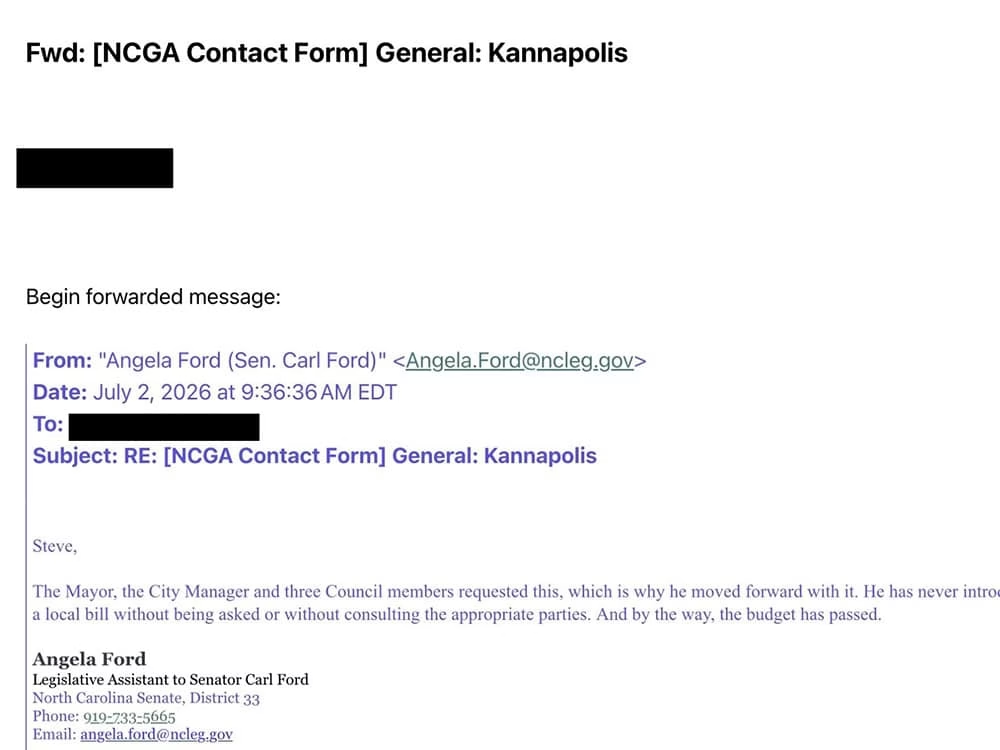
The bill was introduced by Republican Sen. Carl Ford, who represents District 33, which covers Rowan and Stanly counties. According to an email reply from Angela Ford, Senator Ford’s Legislative Assistant, this bill was introduced because “the Mayor, the City Manager, and three Council members requested it.”
The screenshot of the email mentioned above was originally posted in the “Kannapolis Talks” Facebook group. Out of respect for the original post author’s privacy, we have blacked out the citizen’s full name and email address.
If you have questions about this bill, you can find Senator Ford’s office contact information here.
Where the Bill Stands Now
The bill’s current status is Ordered Enrolled. Enrolling is the administrative process of preparing a bill that has passed both chambers and is being prepared as a final, official document.
However, because SB 876 is a local bill affecting fewer than 15 counties, it does not require the Governor’s signature to take effect.
How Current Officials’ Terms Are Affected
To bridge the gap created by canceling the 2027 election, the terms of sitting officials will be extended by one year:
- Council Member Ryan Dayvault – Current Term Expiration: 2027, New Term Expiration: 2028
- Council Member Naomi Hatchell – Current Term Expiration: 2027, New Term Expiration: 2028
- Council Member Darrell Jackson – Current Term Expiration: 2027, New Term Expiration: 2028
- Mayor Doug Wilson – Current Term Expiration: 2029, New Term Expiration: 2030
- Council Member Dianne Berry – Current Term Expiration: 2029, New Term Expiration: 2030
- Council Member Jeanne Dixon – Current Term Expiration: 2029, New Term Expiration: 2030
- Council Member Isaiah Payne – Current Term Expiration: 2029, New Term Expiration: 2030
Under this structure, City Council races will become partisan beginning in 2028, with the Mayor’s race following in 2030.
New Hurdles for Unaffiliated Candidates
The shift to partisan elections raises the bar for candidates who don’t want to run under a party label. Under existing state election law (G.S. 163-296), an Unaffiliated candidate seeking one of these offices must now submit verified petition signatures from registered Kannapolis voters equal to 1.5% of the city’s registered voters as of January 1 of the election year.
It’s important to note that, as of July 2, 2026, Unaffiliated voters are the largest voter bloc in Cabarrus County, with 65,764 registered voters. Followed by the Republican Party with 52,105, the Democratic Party with 43,668, and the Libertarian Party with 1,064.
Key details for Unaffiliated candidates:
- Deadline: Noon on the Friday preceding the seventh Saturday before the election.
- Special petition forms must be obtained directly through the elections office. A generic petition will not suffice.
Running for Office Just Got More Complicated
Beyond the party-label change, candidates will face a more crowded and expensive political landscape starting in 2028:
- Possible multiple elections in a single cycle. If more than three candidates from a single party file for City Council, they could face both a primary and a general election, rather than a single vote.
- A packed ballot. Kannapolis candidates will now compete for voter attention alongside races for President, U.S. Senate, U.S. House, N.C. House and Senate, and County Commissioners, races that traditionally dominate even-year ballots.
- More competition for visibility. With more races on the ballot at once, yard signs, advertising, and campaign spending are all expected to increase, making local campaigns more expensive to run than under the old odd-year, nonpartisan system.
The Kannapolis City School Board Is Not Included, Yet
SB 876 does not affect the Kannapolis Board of Education. However, the Cabarrus County Board of Education itself became partisan two years ago, and this year marks the end of the term for the last members who were elected under the old nonpartisan system. Meaning nonpartisan school board elections in the county are already phasing out on a separate track.
A Statewide Pattern
Kannapolis is not the only municipality affected by SB 876. The bill also converts Albemarle’s municipal elections from nonpartisan to partisan through broader changes to the city’s charter.
More broadly, the North Carolina General Assembly has been actively converting selected municipal elections across the state to even-year, partisan contests. Observers note the timing may not be coincidental. If partisan control of either legislative chamber shifts in a future election, this type of legislation would likely become far more difficult to pass, giving the current majority an incentive to act now.
The Political Backstory
The path to SB 876 traces back to a broader Republican-led push in 2025 to make municipal elections partisan across Cabarrus County, where every municipality currently holds nonpartisan elections.
In March 2025, Republican Rep. Brian Echevarria introduced House Bill 271, which would have let voters in most Cabarrus County municipalities decide via local referendum whether to adopt partisan elections. Because Kannapolis straddles both Cabarrus and Rowan counties, however, HB 271 did not apply to the city. That bill has since stalled, with no action taken since May 2025.
SB 876 took a different route to reach Kannapolis. The bill was originally introduced in late April by Republican Sen. Carl Ford, whose District 33 covers Rowan and Stanly counties, and contained no provisions affecting Kannapolis in its early drafts. The Kannapolis and Albemarle-specific provisions were added on June 25 as part of a conference committee report, shortly before the House and Senate gave the bill final approval.
Cabarrus County’s full legislative delegation, Reps. Jonathan Almond, Grant Campbell, Brian Echevarria, and Sen. Chris Measmer voted in favor of the bill during final passage.
What Comes Next
With final legislative approval secured and no gubernatorial signature required, SB 876’s Kannapolis provisions are on track to take effect. The city’s next regularly scheduled election won’t occur until 2028, when City Council races will be the first to run under the new partisan, even-year system, followed by the Mayor’s race in 2030. This bill is another great example of why every citizen needs to pay attention and understand what their representatives are doing and how it impacts our community.
